What chemicals are in your clothes?
Materials
Article
Colour is where most of fashion's chemical footprint lives.
The fibre debate gets most of the attention. Cotton versus polyester, organic versus conventional, natural versus synthetic. But the fibre is only the beginning of a garment's journey. Before it reaches you, fabric passes through dyeing and finishing. This stage accounts for 53% of a typical garment's total environmental and health impact. It is also the stage that is almost never discussed in brand marketing.
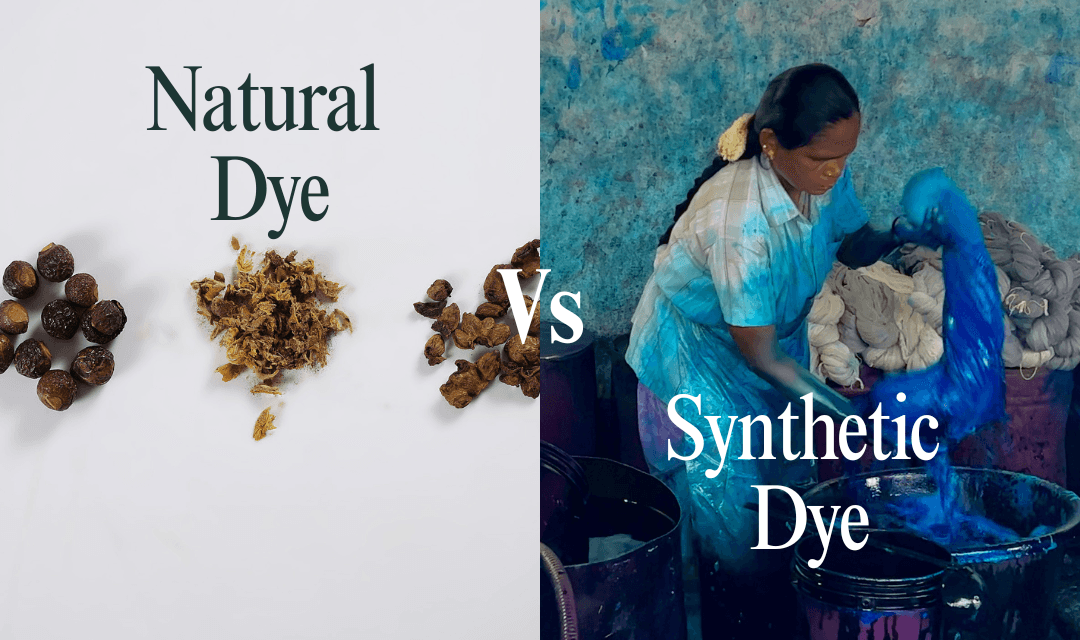
Synthetic dyes are derived from petrochemicals. They were developed in the mid-19th century as a cheaper, more scalable alternative to natural dyeing and now colour over 90% of all textiles produced globally. They are effective. They produce bright, consistent, stable colour at low cost. They are also chemically complex in ways that rarely get explained to the person buying the shirt.
Reactive dyes, the most common class used in cotton dyeing, bond to fibre through a chemical reaction that requires fixatives, salts, and alkaline agents. Azo dyes, another widely used class, can release aromatic amines under certain conditions, compounds classified as potentially carcinogenic by the European Chemicals Agency. Optical brighteners, added to make whites appear whiter, are synthetic compounds that sit on the fabric surface and fluoresce under UV light. PFAS-based finishes, used to repel water and stains, are now found in the bloodstream of populations across every continent.
Natural dyes work differently at a fundamental level. They are derived from plant matter, roots, bark, leaves, flowers, vegetables, fruits. They bond to fibre through natural mordanting processes without synthetic fixatives. They break down in the environment without leaving synthetic residue. They produce colour that is softer and more variable than synthetic alternatives, which is both a limitation and, depending on how you look at it, a quality.
The honest difference is this. Synthetic dyes optimise for consistency and cost. Natural dyes optimise for safety and end of life. Neither is a perfect solution to the process of colouring fabrics at scale. But only one of them can name all ingredients used, trace to its source, and be confirmed to leave nothing harmful behind.
At alltheway, every garment is dyed using 100% plant-based dyes. And with no chemical mordants. We use a unique dyeing method that combines the consistency of machine processes with the integrity of hand dyeing, which gives our colours more longevity than conventional natural dyeing while maintaining everything that makes natural colour honest.
The colour will evolve over time. It softens rather than deteriorates. We think of this as the garment developing a history rather than ageing.
© 2026 alltheway. All Rights Reserved