
You know what you eat. You have no idea what you're wearing.
Materials
Article
The biggest chemical decision in a garment isn't the fabric. It's the colour.
Most conversations about sustainable clothing focus on materials.
Cotton versus polyester. Organic versus conventional. Natural versus synthetic.
But fabric is only the beginning of a garment's journey. Before it reaches your wardrobe, it must be dyed and finished. This stage accounts for a significant share of a garment's environmental and health impact, yet it is rarely discussed.
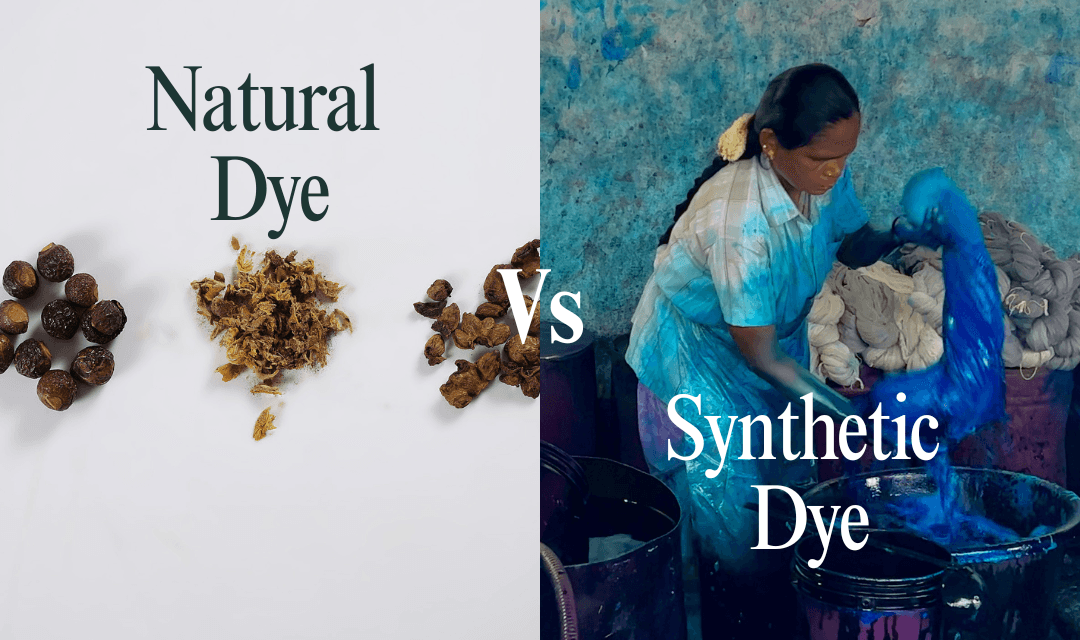
Today, more than 90% of textiles are coloured using synthetic dyes.
Developed in the 19th century, synthetic dyes became the industry standard because they are affordable, scalable, and highly consistent.
They produce bright colours that are easy to replicate at industrial scale.
What they don't provide is transparency.
The dye itself is only one part of the process.
Many modern dyeing systems rely on additional chemical inputs to achieve colour fastness, consistency, and performance.
These can include:
- Reactive dyes
- Azo dyes
- Fixatives
- Salts and alkaline agents
- Optical brighteners
- Water and stain-resistant finishes
- PFAS-based treatments
Most consumers never see these ingredients listed anywhere.
A garment label will tell you the fibre content.
It won't tell you how the fabric was coloured. It won't explain what was added during finishing. And it won't disclose the chemical systems used to achieve a particular shade or performance feature.
For most clothing, that information remains invisible.
Natural dyes are derived from plants, roots, bark, leaves, flowers, fruits, and vegetables.
Rather than relying on synthetic dye systems, they use naturally derived colour sources and traditional bonding processes to attach colour to fibre.
Because they originate from natural materials, they break down more easily at the end of a garment's life without leaving synthetic residues behind.
The trade-off is relatively simple.
Synthetic dyes are optimised for consistency, efficiency, and cost.
Natural dyes are optimised for ingredient transparency and environmental compatibility.
Neither approach is perfect. But only one can trace its colour back to identifiable natural sources and fully disclose what goes into the process.
At alltheway, every garment is dyed using 100% plant-based dyes.
We use a specialised dyeing process designed to combine the consistency of modern production with the integrity of traditional natural dyeing.
The result is colour that lasts while remaining true to its source.
Natural colour isn't static.
Over time, it softens rather than deteriorates. Small shifts in tone become part of the garment's story rather than a sign of failure.
We see this as a feature, not a flaw.
A garment should develop character with age, just like the person wearing it.